A Quick Word From Your Trail Correspondent (Me, Exhausted)
The Colorado Trail:
782 kilometres.
20,000 metres of elevation gain.
4 – 6 weeks for the average hiker.
I am not the average hiker. I would like to think I’m above average. The trail disagrees. And so do many many many other hikers who have worked out how to be legitimately ultralight (UL)… ie… they don’t usually pack their dog… or a thermos, or nail polish. What can I say? I wasn’t interviewed for the job.
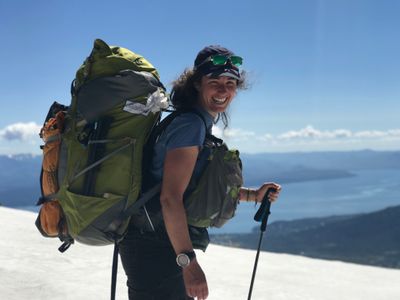
I’m currently somewhere in the middle of the Colorado Trail — self-supported, one foot in front of the other, deeply reliant on hot chocolate as a coping mechanism. Wombat is away on a training program with his trainer Dylan, which I’m choosing to feel good about and not at all like I’ve been abandoned by my own dog. The trail doesn’t care about this. Neither does the elevation.
Anyway. That’s the backdrop. Now let me tell you about the woman I ran into out here, because she is something else entirely.
A Crash Course in How Hikers Are Built Different (Some More Than Others)
Before I get to her, I need to give you a tiny bit of context — because the hiking world has its own language and if I just drop terms on you without explanation, you’ll nod politely and understand nothing. (I’ve been there. Be grateful we’re not doing this in Spanish.)
Thru-hiking means walking the entire length of a trail (usually one longer than 1000km). Within that, section hiking is exactly what it sounds like — you tackle the same trail in chunks over months or years rather than all at once. Totally valid. And in many cases ensures you appreciate the trail rather than being saturated by so many dramatic features and no longer being able to take it in.
Then there’s the question of support. Which, in hiking terms, is as much emotional as it is logistical.
Unsupported is the hardcore end. You carry everything. All your food, all your gear, all your suffering, for the entire journey. No resupply drops. No stepping off trail, not even for water. It requires the kind of planning that makes spreadsheets look casual, and a tolerance for discomfort that borders on a personality type.
Self-supported is where I usually live. You carry your kit, but you plan to resupply along the way — food caches, mail drops, towns. It’s a balance. You’re still doing the work, but you’re not a pack mule for the full duration.
And then there’s supported — having a crew. Family, friends, people who meet you along the way for pacing speed, or to handover fresh food, gear, encouragement, possibly a massage chair you didn’t have to carry. Coordinating support is its own logistical nightmare. But it allows for faster movement and lighter packs.
At the end of Mexico, I briefly tipped into supported territory. It’s humbling. Also wonderful. Mostly wonderful… if they sign a non-disclosure statement…
And then — above all of these — there are the FKT chasers.
FKT stands for Fastest Known Time. These are hikers attempting to complete a trail in record time, under strict verified conditions. It is a different sport. I am not playing it… though technically because I’m the first, I’m also the one to beat
The unsupported FKT for the Colorado Trail is 11 days, five hours and 45 minutes.
Read that again.
782 kilometres. 20,000 metres of elevation. Eleven days.
As Bill Bryson once wrote about the Appalachian Trail: “The woods were full of people who had set out to walk it and who were, at various stages, regretting the decision.” I think about that line a lot. The FKT crowd, though? They have no regrets. They just have a timer.
The Part Where I Meet Someone Running on a Different Clock
So there I am. Moving at my pace. Which is a perfectly respectable pace for someone carrying their life on their back with no dog to distract them and therefore zero excuse to stop.
And I cross paths with Dena Carr.
Dena is attempting an unsupported FKT of the Colorado Trail. Which means she’s out here, alone, carrying everything, trying to do in under 11 days what most people take a month and a half to do.
She was moving like the trail owed her something, and she still stopped to say hi.
I don’t know what I expected — someone locked in, head down, no time for anything. Perhaps a sign that says “FKT attempt. I can’t stop”, or my go-to, oversized headphones. And I get it. When you’re chasing a record, every minute is like a school bell . The maths of an FKT doesn’t really leave room for standing around having a chat.
But she stopped.
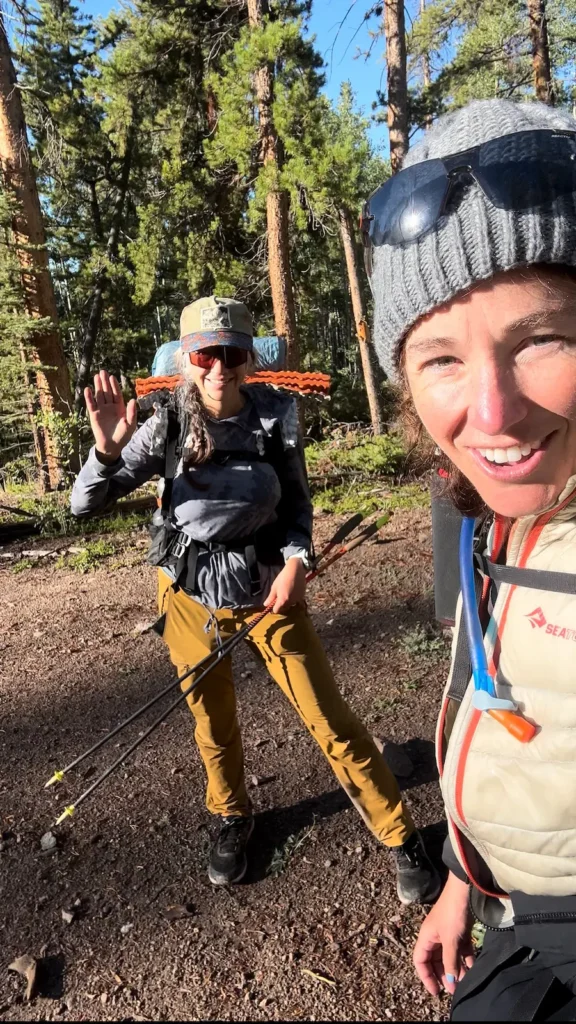
Not just for a moment. Long enough to actually be a person in a conversation, not just a blur going past in trail runners. There was something about that — the fact that going that fast, that focused, she still had space in her to pause..
I’m not Dana Carr. I’m not chasing a record. I’m out here on a completely different clock, and I move accordingly. … or should I say I chat accordingly.
But I think about what it takes to move like that. Not just physically — though yes, physically, it’s staggering. But mentally. To hold that pace, that singular focus, across terrain that is legitimately trying to stop you.
It’s the kind of thing that forces you to recalibrate what you think you’re capable of.
Didn’t say anything to Dena about that, obviously.
Just said good luck. Stupidly offered her a Gu energy gel for her to have to decline (gifts are against the rules). Immediately hid it behind my back. And gave her a hug instead.
Meant it completely. Dena you’re a true trail queen!
To follow Dena visit her instagram.
If you want to follow along properly — FKT maths, trail terminology, and the occasional encounter that stops you in your tracks — join Entangled. It’s my inner circle and it’s where a genuine community lives. Or if you just want to shout me a warm-up-coffee or a self-pity-hot-chocolate to keep me moving: same link.
Lucy + Wombat 👩🌾🐶
